
Architecture
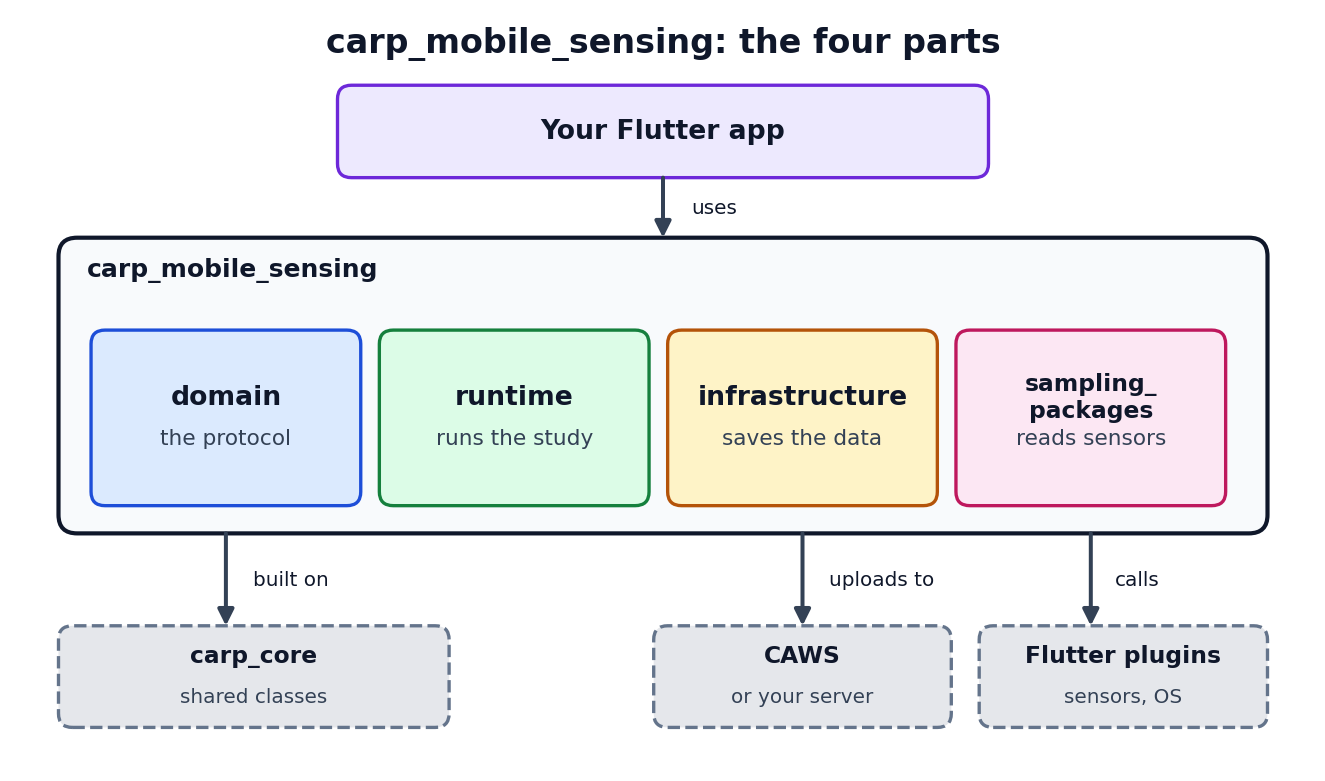
carp_mobile_sensing is one Dart package with four parts. Each is a folder under lib/, and each has its own section in this documentation.
| Part | Folder | Answers |
|---|---|---|
| Domain | lib/domain/ |
What is a study? Protocol, triggers, tasks, measures, devices |
| Runtime | lib/runtime/ |
How is it run? Client manager, executors, task queue |
| Infrastructure | lib/infrastructure/ |
Where does it go? Data managers, persistence, notifications |
| Sampling packages | lib/infrastructure/sampling_packages/ |
Where does the data come from? Probes for sensors and devices |
Sampling packages sit in a subfolder of infrastructure/ but are exported as their own library (lib/sampling_packages.dart). Most sampling packages are separate pub.dev packages.
Terms used below
Section titled “Terms used below”| Term | Meaning | Details |
|---|---|---|
| Study protocol | The description of a study, written in Dart: what to collect, when, and where to send it | Study protocol |
| Trigger | When something happens, e.g. at 08:00 every day, or right away | Triggers |
| Task | What to do when a trigger fires. A background task collects data silently. An app task asks the user to do something, e.g. fill in a survey | Tasks |
| Measure | One kind of data to collect, e.g. steps or screen events | Measures and data |
| Measurement | One collected value of a measure, with a timestamp | Measures and data |
| Probe | The code that reads one sensor or device and produces measurements | How sampling packages work |
| Sampling package | A set of measures with the probes that collect them | Sampling packages |
| Executor | The runtime object that carries out a trigger, task or probe | Executors |
| Data manager | Stores or uploads measurements | Data managers |
The four parts
Section titled “The four parts”Domain
Section titled “Domain”The classes that describe a study: the protocol, its triggers, tasks and measures, and the data classes. Its responsibility is to say what the study is. It does not run anything.
Runtime
Section titled “Runtime”The code that runs a study on the phone. You start, pause and resume studies through SmartPhoneClientManager, and executors carry out the triggers and tasks. Its responsibility is to run the study and keep the list of tasks the user has to do.
Sampling packages
Section titled “Sampling packages”The code that reads sensors and devices. Each package offers a set of measures and a probe for each one. Its responsibility is to collect the data.
Infrastructure
Section titled “Infrastructure”The services around the study. Data managers store or upload measurements, persistence saves the state so a study resumes after a restart, and notifications and background execution work with the OS. Its responsibility is everything that saves data or talks to the OS.
How the parts relate
Section titled “How the parts relate”lib/domain/ has two folders:
core/is the study: protocol, triggers, tasks, measures, devices, data classes.services/holds the interfaces CAMS can be extended through:DataManager,NotificationManager,StudyProtocolManagerandSamplingPackage. They declare what is needed. They are not part of the protocol.
The other parts fill them in:
Interface (domain/services/) |
Implemented in |
|---|---|
DataManager |
Infrastructure: console, file and SQLite data managers |
NotificationManager |
Infrastructure: FlutterLocalNotificationManager |
StudyProtocolManager |
Infrastructure: FileStudyProtocolManager |
SamplingPackage |
Sampling packages: device, sensors, and your own |
Replace an implementation to change how CAMS stores data or notifies. Register a new SamplingPackage to add measures.
This is not a strict layering. The interfaces refer to runtime classes (NotificationManager takes a UserTask, SamplingPackage returns a Probe and a DeviceManager), and the runtime uses the domain classes. They are folders of one package.
Outside the package
Section titled “Outside the package”| Outside | Role |
|---|---|
carp_core |
Shared domain classes, used by the domain part |
| Flutter plugins | Access to sensors and the OS, called from probes |
| CAWS or your server | Optional. Deploys studies and receives data, through a data manager |